Deep gluteal syndrome and piriformis: sciatic nerve
The deep gluteal space is the region where the sciatic nerve leaves the pelvis and relates to piriformis and the deep hip rotators. Piriformis syndrome is one of the causes of this deep gluteal syndrome. These relations are shown here in 3D.
Anatomy of the passage
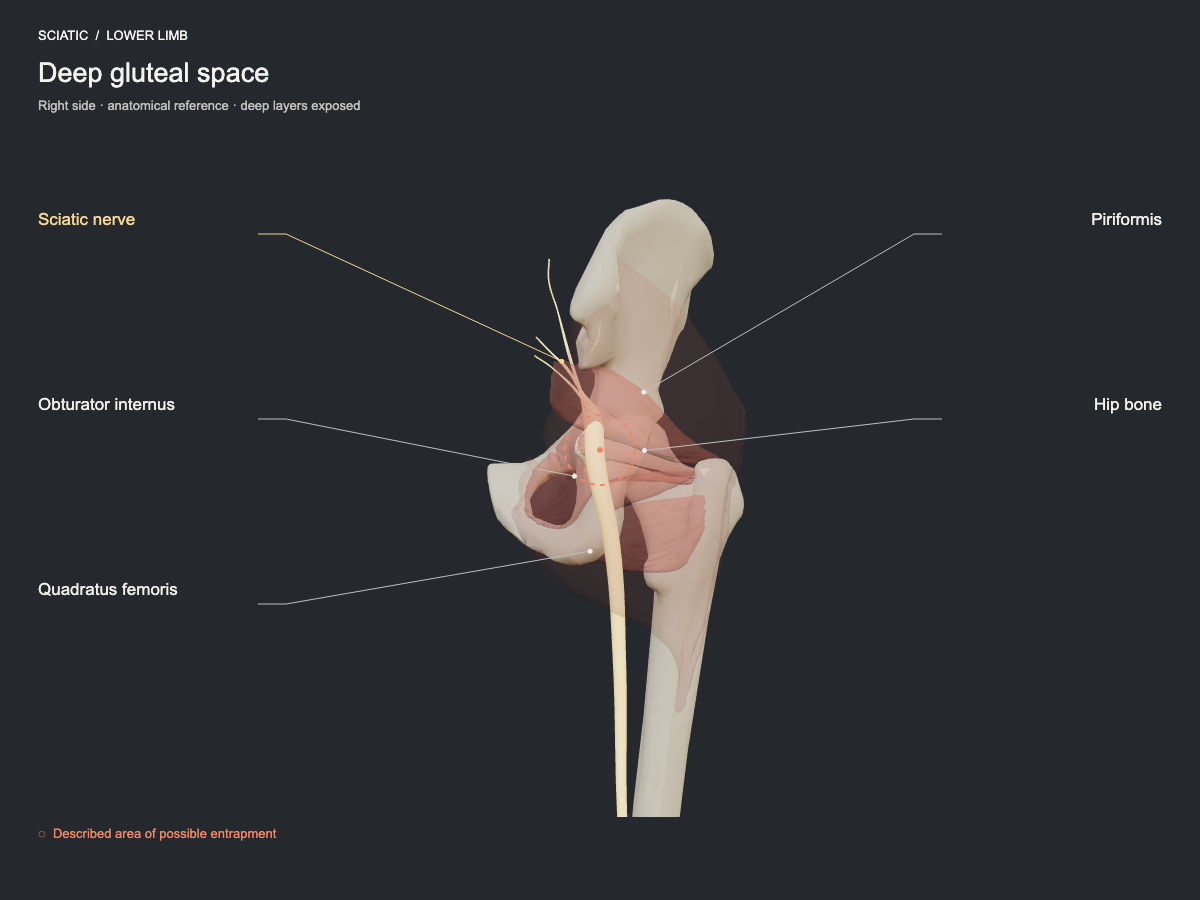
The sciatic nerve is related to piriformis and the deep rotators of the hip. Deep gluteal syndrome covers extraspinal entrapments by different structures; attributing any sciatic pain to piriformis oversimplifies its diagnosis.
- Nerve
- Sciatic nerve: deep gluteal space and ischial region
- Frequency
- Described site, less commonly seen.
- Type of evidence
- Systematic review and clinical anatomy
References
- Kizaki K, Uchida S, Shanmugaraj A, Aquino CC, Duong A, Simunovic N, Martin HD, Ayeni OR. Deep gluteal syndrome is defined as a non-discogenic sciatic nerve disorder with entrapment in the deep gluteal space: a systematic review. Knee Surg Sports Traumatol Arthrosc 2020. PubMed 32246173 · DOI
- Kay J, de Sa D, Morrison L, Fejtek E, Simunovic N, Martin HD, Ayeni OR. Surgical Management of Deep Gluteal Syndrome Causing Sciatic Nerve Entrapment: A Systematic Review. Arthroscopy 2017. PubMed 28866346 · DOI
Ultrasound landmarks
In the deep gluteal region, the sciatic nerve emerges below piriformis and descends behind the gemelli, obturator internus and quadratus femoris, covered by gluteus maximus. Deep station.
Tests that load this nerve
Other sites of the same nerve
All entrapment sites
Get atlas news
We will write to you when the plans open and when there is new content.